
For more than three decades, Great Lakes volunteers have done more than remove litter. Their work has built a clearer picture of plastic pollution and helped strengthen efforts to address it.
Every year, thousands of people head to Great Lakes beaches, parks, trails and marinas to pick up litter. It’s an activity with an immediate result: a cleaner shoreline.
But after 35 years of the Alliance for the Great Lakes’ Adopt-a-Beach program, the cumulative impact is much larger.
Since the Alliance began tracking cleanup data in 2003, volunteers have removed more than 500,000 pounds of litter and documented more than 10 million individual pieces. In the process, they have created a decades-long record of what’s ending up along Great Lakes shorelines.
From cleanup to community science
Adopt-a-Beach volunteers don’t simply collect litter. They record what they find.
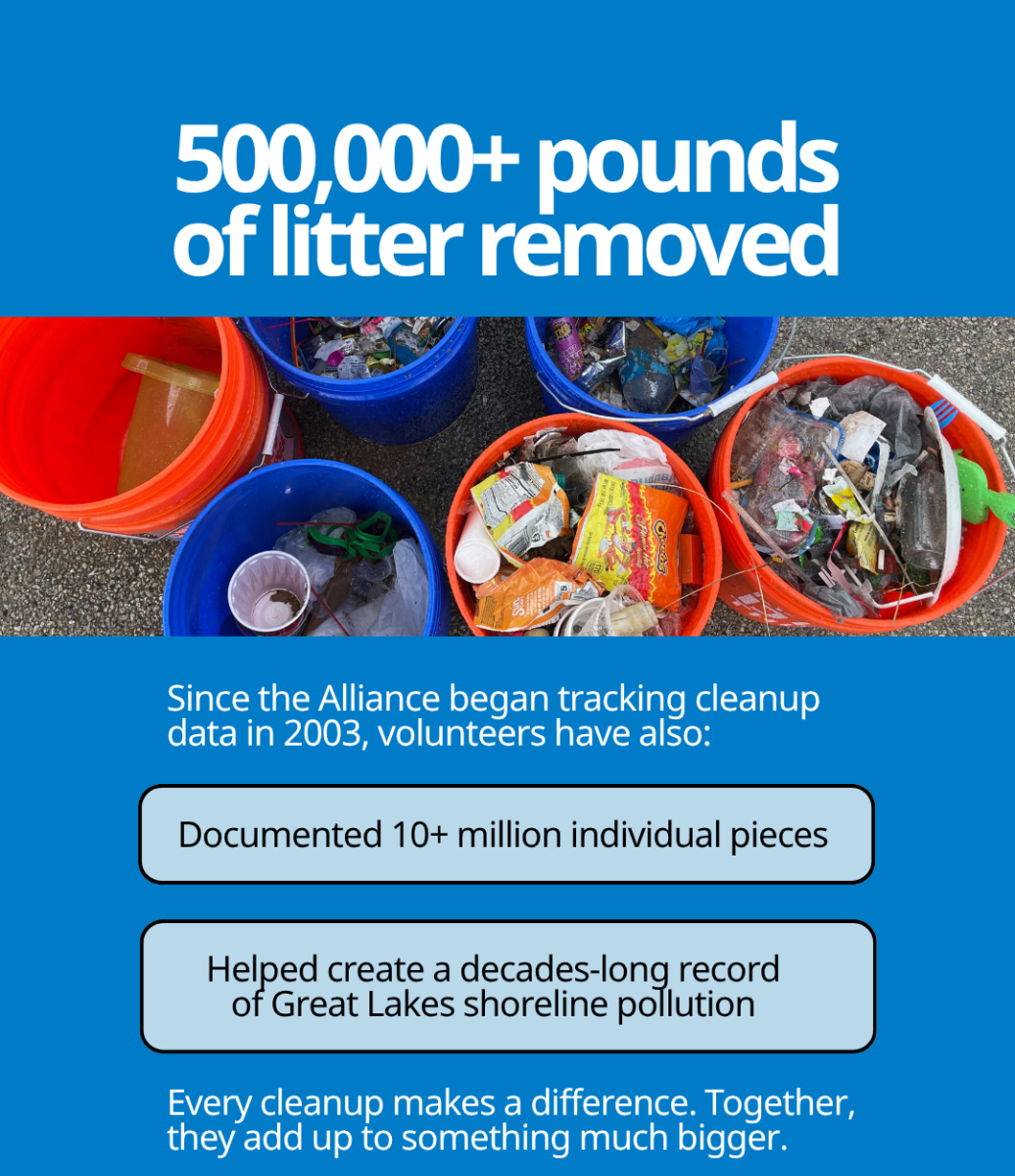
That information has helped reveal the scale of plastic pollution across the region. A 2024 analysis of data from more than 14,000 cleanups found that 86% of the litter collected was made partially or fully of plastic. Forty percent was “tiny trash,” fragments smaller than a bottle cap.
Because volunteers return to shorelines year after year, the data can reveal patterns that are difficult to see from any single cleanup. It has become a resource for researchers, educators, and policymakers seeking to better understand Great Lakes pollution.
Data that travels beyond the beach
In 2025 alone, Adopt-a-Beach data was used in high school and college classrooms and an MBA data analytics seminar. It also helped inform testimony on proposed legislation in Michigan to begin monitoring microplastics and in Illinois to phase out plastic foam foodware.
The connection is an important one: What volunteers find locally can contribute to a much broader understanding of the sources and scale of plastic pollution and the policies needed to address it.
A Great Lakes community, 35 years strong
The program’s impact is also reflected in the people behind the data.
In 2025, more than 10,500 volunteers contributed over 24,000 hours across 931 cleanups, removing more than 11 tons of litter. Over the program’s history, participants have included families, students, businesses, faith groups, and community organizations. Many volunteers have returned year after year, while others have gone on to lead cleanups of their own.
Thirty-five years after Adopt-a-Beach began, its legacy can be seen in cleaner shorelines, better information, smarter approaches to pollution and a stronger community committed to protecting the Great Lakes.
The next 35 years start with the same action as the first: showing up.
Find or host an Adopt-a-Beach cleanup near you.