
When not properly managed, manure from concentrated animal feeding facilities can pollute our waterways and contribute to toxic algal blooms in the Great Lakes. The current rules in Ohio say facilities above a certain size need to get permits and properly handle, store, and land apply their waste. But a loophole allows producers to own and operate two smaller facilities near each other, combine their waste, and avoid those requirements. As “separate” facilities, they can dodge critical protections designed to reduce the concentration of that waste and keep it out of our water. Last month, an important Ohio committee declined to recommend closing that loophole. This can lead to more pollution in our waterways, which contributes to toxic algal blooms in Lake Erie, a source of drinking water for thousands of Ohioans.
Below in greater detail is the story of how after nearly a year of deliberations, Ohio’s Concentrated Animal Feeding Facility (CAFF) Advisory Committee missed an opportunity to recommend meaningful action to address this common ownership issue, leaving a known weakness in the state’s regulatory system unresolved. To understand what happened and why it matters for Lake Erie and Ohio waterways, it is helpful to examine how the state permits concentrated animal feeding facilities, what common ownership means, and what the Committee is and what it was asked to do.
Concentrated Animal Feeding Facilities and common ownership
In Ohio, concentrated animal feeding facilities (CAFFs) must apply for and obtain permits from the Ohio Department of Agriculture’s (ODA) Division of Livestock & Environmental Permitting (DLEP) before their operations exceed specific animal unit thresholds. A Permit to Install (PTI) is issued by ODA to producers who are in the planning stages of developing or modifying a CAFF. Its purpose is to help ensure the proposed building, facilities, and location will adequately support the operation. A Permit to Operate (PTO) is issued by ODA to producers who wish to operate a CAFF in Ohio. Its purpose is to ensure that the proposed facility has developed appropriate best management plans in the areas of manure management, insect and rodent control, animal mortality, and emergency response. For example, as part of a PTO, a CAFF owner or operator must submit a nutrient management plan, demonstrating how the CAFF will handle manure, including whether the CAFF has access to adequate acreage on which to spread manure in compliance with land application rules. Both a PTI and PTO must be obtained before operations begin.
The idea behind these permit requirements is that at these levels of animal concentration, there’s an increased risk that manure generated by the animals might make its way into Ohio’s waterways, necessitating additional oversight by the state to ensure that operations are following the law and that manure is handled properly. Under these laws, two or more animal feeding facilities that are under the animal unit thresholds, but are commonly owned, are considered one operation if they adjoin each other or if they comingle their manure.
What is the Concentrated Animal Feeding Facility (CAFF) Advisory Committee?
The Ohio Concentrated Animal Feeding Facility (CAFF) Advisory Committee was created by the Ohio legislature to advise Ohio’s Director of Agriculture on the administration of the permit program. Sixteen members appointed by the Director represent various segments of the population affected by industrial agriculture, including livestock industry representatives, members of the public, and governmental advisors. The Committee’s input directly informs administrative rules governing the industry.
Why was common ownership before the CAFF Advisory Committee?
After hearing many comments from the public, status updates and presentations from DLEP, and a request from the Director, the CAFF Advisory Committee voted to form a subcommittee to tackle making recommendations to the Director on how the common ownership and manure management issues should be addressed. That vote was unanimous. The Committee met and deliberated three times over the course of almost a year to attempt to arrive at a set of recommendations.
While much discussion was had about defining the term common ownership, deliberations revealed that ODA has the legal authority it needs to determine where common ownership exists. More challenging for ODA is proving that common ownership exists where facilities don’t adjoin and aren’t side by side. The test for whether two facilities are one and therefore must obtain a permit is whether they are under common ownership and either:
- Adjoin; or
- Comingle manure.
Comingling of manure is highly challenging for ODA to prove because ODA does not have any information about where manure is land applied from operations that don’t hold CAFF permits or that isn’t applied by certified livestock managers. There are about 300 permitted CAFFs in Ohio, but there are thousands of smaller operations that are not required to register or obtain a permit from ODA.
Nutrient management plan requirements are the key to solving this challenge because they could help provide ODA with this information while simultaneously improving manure management. For example, in Grand Lake St. Mary’s, a watershed in distress designation was applied that imposed a nutrient management plan requirement. Water quality improved significantly as a result.
What did the CAFF Advisory Committee end up recommending?
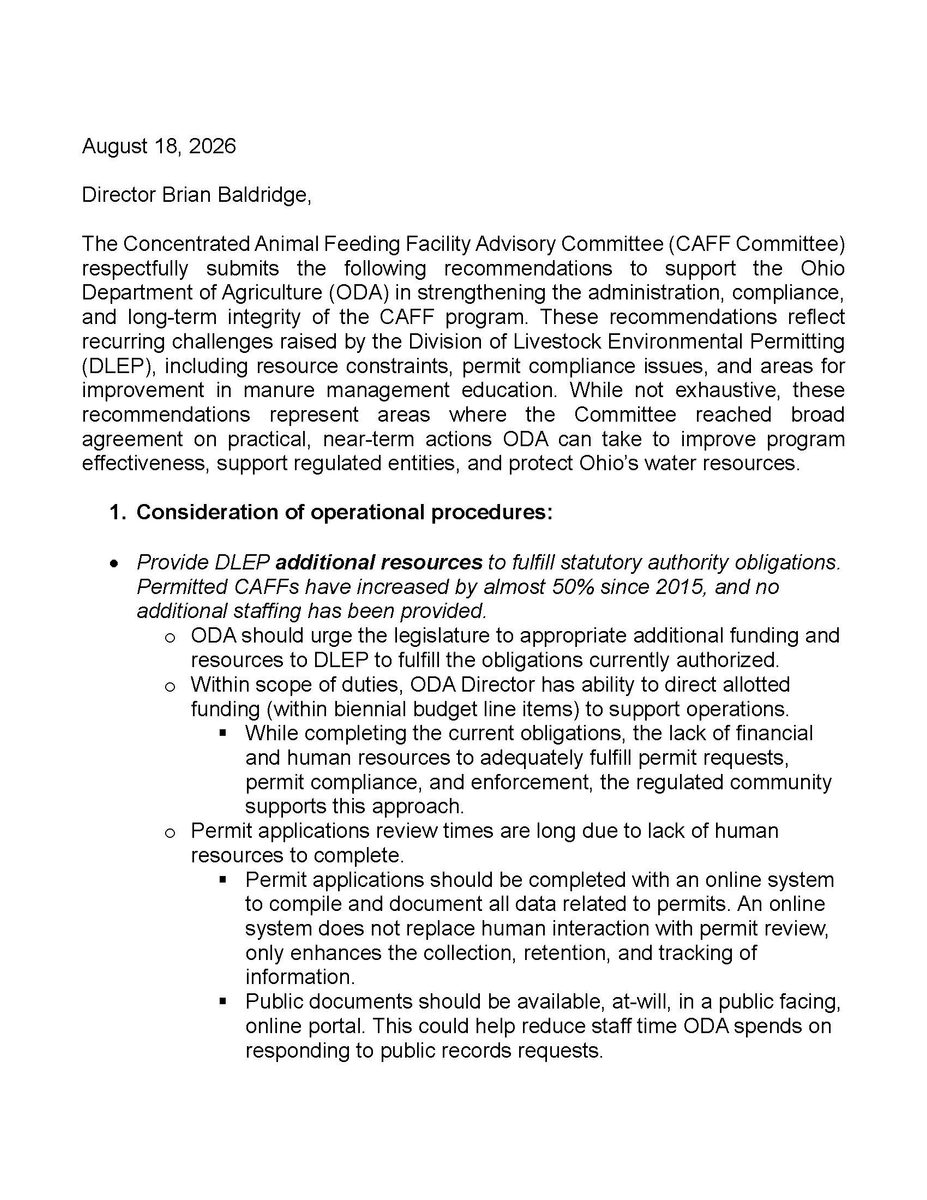
After three subcommittee meetings and two full committee meetings, the Committee ended up making 2 recommendations:
- Increase funding to ODA’s DLEP to increase staff capacity to conduct permit reviews and enforcement; and
- Fund and task Soil and Water Conservation Districts (SWCDs) with emphasizing the importance of nutrient management plans.
Why didn’t it go far enough?
Ultimately, the Committee missed an opportunity to recommend solutions to the Director that would meaningfully allow ODA to address common ownership issues before permit violations occur by improving its overall oversight of manure management. Operators have also had ample assistance with nutrient management planning — since the creation of the H2Ohio program in 2019, operators have been eligible to receive funding to prepare nutrient management plans and encouraged to work with and receive assistance from SWCDs to prepare them. Moreover, before either of the Committee’s recommended solutions could be implemented, the Ohio legislature would need to appropriate additional funding to ODA for these purposes. By contrast, ODA could immediately revise its rules to require animal feeding facilities that generate a certain threshold volume of manure to prepare and submit nutrient management plans to ODA. Some members of the subcommittee did advocate for this approach, but it did not make it into the final recommendation letter that the Committee approved.
What happens now?
ODA and the Attorney General are currently pursuing civil penalties against operations that violate the law governing common ownership and manure management. The Director of ODA has received the Committee’s letter and will have to determine how and whether to pursue its recommendations. However, because those recommendations won’t fully resolve the common ownership and underlying manure management issue, it is likely that the next time there’s a significant bad actor, the Committee will be back debating these issues again.