
When heavy rain happens in Chicago, too many Chicagoans suffer basement backups and flooding in their homes and neighborhoods. Frequent flooding disproportionately affects vulnerable communities, leading to expensive property damage, chronic public health risks, ongoing economic instability, and profoundly reduced quality of life.
With new commitments from Chicago and Cook County to address historical disinvestment, there is a unique opportunity to address persistent community flooding and sewage backups in communities with failing water infrastructure.
The Alliance for the Great Lakes is a member of the Flooding and Sewage Coalition, a cross-regional coalition working to address flooding and sewage issues on the South and West Sides of Chicago, the South Suburbs, and Northwest Indiana.
The comment letter below, written in collaboration with both Flooding and Sewage Coalition members and a Community Advisory Committee, was submitted to Chicago’s City Council Committee on Environmental Protection and Energy on August 31, 2026, and followed up with personalized verbal testimony on September 1, 2026, in person, at the special subject matter hearing on Urban Flooding:
Dear Members of the Committee on Environmental Protection and Energy,
The Flooding and Sewage Coalition respectfully submits public comment regarding urban flooding and stormwater mitigation. We are a diverse coalition working across multiple flood-vulnerable communities to address flooding and sewage issues.
Across Chicago, residents in neighborhoods with inadequate stormwater and wastewater management systems are experiencing frequent flooding and sewage backups, leading to property damage, public health risks, and economic instability — all of which further a cascade of historic and ongoing disinvestment. Black and Latine communities are the most vulnerable. The proper response to this crisis requires a broad coalition of voices to provide complete, equitable, and sustainable solutions so that legacy residents are positioned to rebuild their own communities and to thrive within a changing climate.
Flooding is not a new problem for Chicago — and climate change is making it worse. Chicagoans are experiencing raw sewage backing up through house plumbing, impassable streets and sidewalks, waterlogged cars, and polluted water submerging yards and flowing into homes. This summer alone, we’ve experienced back-to-back storms that resulted in hundreds of 311 calls about flooded basements, streets, and viaducts.
Data on flooding from 311 calls is useful, but overreliance on formal reporting mechanisms like 311 complaints and insurance claims likely undercounts flooding in environmental justice communities. Residents may underreport flooding because of language barriers, lack of time, distrust of government, fear of landlord retaliation, fear of immigration-related consequences, lack of insurance, prior experiences of nonresponse, or uncertainty about whether reporting will lead to assistance. Recent news reporting and conversations with community members have highlighted that many flooded neighbors are avoiding calls to 311.
Climate change is making flooding worse – especially for those bearing the greatest historic and chronic burdens of pollution.
Flooding doesn’t impact all Chicagoans equally. As stated in the City of Chicago’s recently published Green Infrastructure Strategy, “These impacts are disproportionately felt by Black and Brown communities on Chicago’s South and West Sides, where environmental burdens and decades of underinvestment have made it harder to recover from storms…Historical policies and industrial development have compounded environmental burdens in these neighborhoods.”
An analysis of insurance data over a ten-year period backs this up. Nearly ninety-percent of flood damage claims were made in Chicago’s Black and Brown neighborhoods – at a cost of over $400 Million in payments. This doesn’t include denied and reduced payments, seepage (which is uninsurable), or flooding experienced by uninsured tenants and building owners.
Flooding hurts Chicagoans’ health, finances, and safety.
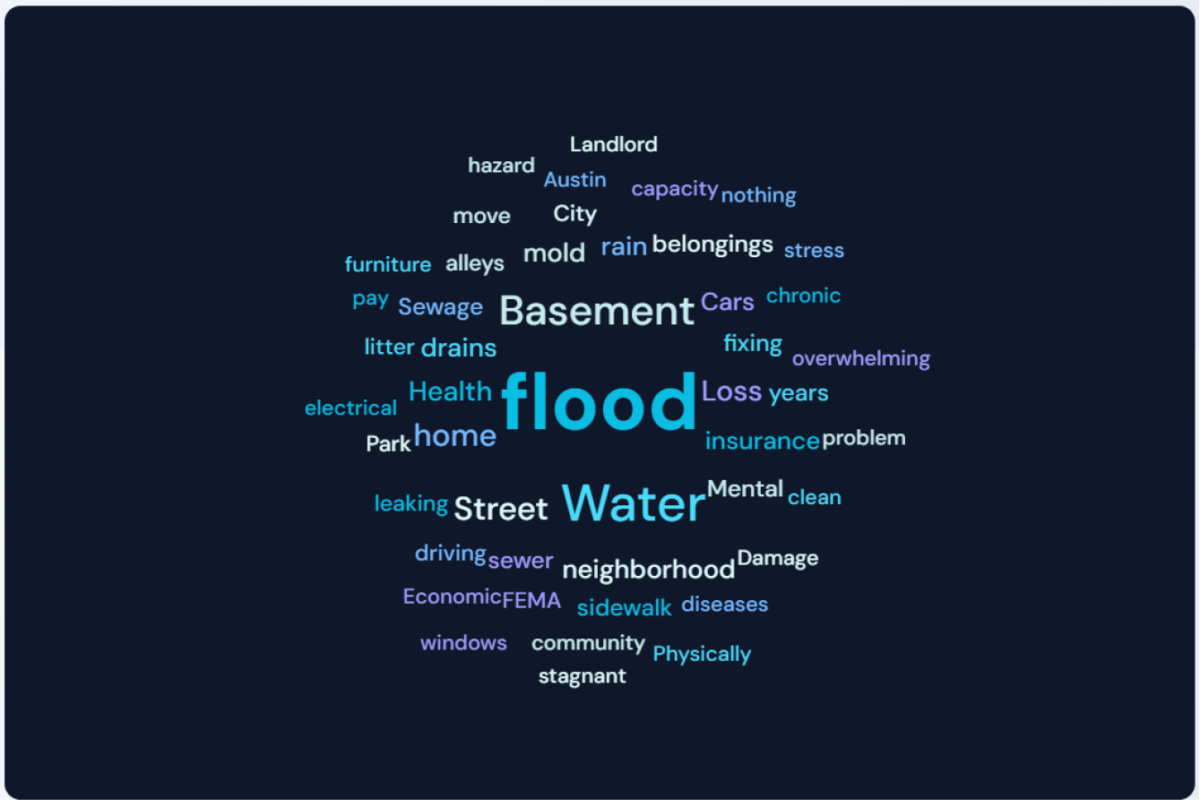
The Flooding & Sewage Coalition has spent the past year talking with community members who are most vulnerable to flooding in heavily impacted Chicago neighborhoods. Over and over, residents spoke about the health and financial impacts of flooding in their home. More than half spoke about health impacts due to stress and mold. More than a third said that flooding impacted them financially, due to cost and time spent repairing basements, cleaning up mold and sewage, and replacing belongings. Some sentimental items were irreplaceable, lost forever.
“My elderly sister was so stressed she got sick and we lost a lot of furniture and my album collection.”
“Flooding has destroyed personal items and structural components of my home since childhood.”
“frustración al perder lo material y no poder hacer algo”
“I live in Garfield Park and my basement regularly floods at least 4 and a half feet, destroying my boiler.”
“We have to deal with the burden and trauma of throwing away all of our sentimental valuables, and then pay to get it removed, and if we don’t let the appropriate people know to remove it, we have to pay a fine. It’s all overwhelming and too much to keep track of, while dealing with the constant flooding itself. The mental load is so taxing.”
“The city or neighbors aren’t coming to check up on me…I feel alone.”
Residents also highlighted the dangers of flooded streets. One community member said, “Flooding is a safety hazard not just because of the water, but because cars will swerve to avoid water on the highways causing accidents, hydroplaning, etc.”
As currently structured, home insurance and FEMA disaster funding isn’t the full solution, either. Residents told the Flooding & Sewage Coalition,
“Insurance feels overwhelming to understand and when you do understand it, you realize it feels like a scam, most things aren’t covered or there’s a huge deductible you have to pay before the work is even done.”
“When I bought my home, I was a first time homebuyer and I was told flood insurance was unnecessary; FEMA’s flood zones don’t represent actual lived experience.”
Flooding also exacerbates the city’s ongoing affordable housing crisis. Community members spoke about unresponsive landlords, moving after repeated home flooding, and fearing the loss of their home.
“When you have a mortgage loan, and has issues you can’t keep up with, you lose your property or have to suffer through it.”
“Senior citizens are among the most vulnerable, many of us are afraid to lose our homes we worked hard for, so we endure through the mold.”
“Landlord did nothing to fix the water in the garden apartment, in fact, [they] threatened to call ICE.”
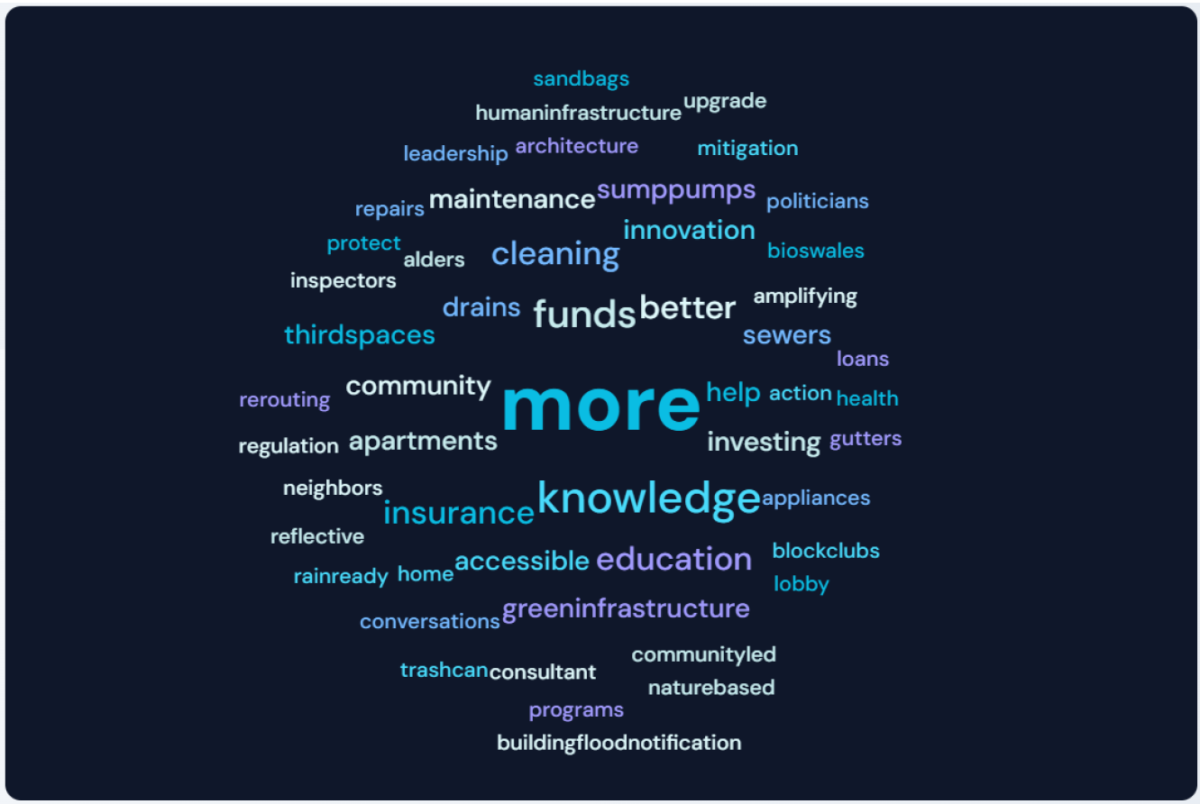
Chicagoans are asking for the City’s leadership to address flooding.
Community members have identified the solutions they want to see. Survey data indicates that residents want assistance with home protection improvements, more green infrastructure, and better maintained sewer systems. Residents are asking for government leadership in upgrading infrastructure, supporting flood communication, and offering financial assistance. In some instances, residents want support in relocating to other houses or neighborhoods when the houses they live in are beyond repair due to decades of ongoing storm-related damage.
Federal aid can no longer be counted on to address Chicago’s long-standing and worsening flooding. The Flooding & Sewage Coalition has identified a number of potential funding solutions to support flood prevention and assistance programs. We look forward to discussing options for the State, MWRD, and City at a future time.
A community-responsive coordinating body is needed to address Chicago’s flooding problem.
The City’s leadership is needed in this critical time. Currently, no single agency or department is tasked with supporting flood victims across the entire process, from flood prevention and flood repairs to healthcare and housing. As a result, flood victims are caught in the middle of many different organizations, trying to find a solution.
“Flooding in [the] alleyway of [my] parents’ home made it hard to get cars in [the] garage; Dad spent a year going to different aldermen trying to solve the issue.”
“FEMA is telling people to use their insurance, meanwhile insurance is telling people to use FEMA. Insurance doesn’t cover much, if anything, and so we end up with nothing.”
“…the City came out and took pictures and stated that they’d be back to do work and it’s been months and no one has shown up to do anything.”
Residents need immediate FEMA response, and long-term City investment in green infrastructure and sewer pipes and pumps to address flooding, but must contend with a lack of coordination across many City departments and other agencies to accomplish this goal.
That is why the Flooding & Sewage Coalition would like to collaborate to ensure that the Moseley ordinance, which proposes to create an Urban Flooding and Climate Resiliency Task Force, results in a community-informed, community-responsive coordinating body.
By including the voices of impacted residents in this interagency task force, Chicago can make meaningful progress on flood prevention through green infrastructure and sewer system improvements, protecting the health and livelihood of our community members.